
Neutralite avidin high temperature resistance
High Temperature Resistance : Superior Performance of Neutralite Avidin
Neutralite Avidin Shows Higher Temperature Resistancecompared to native avidin
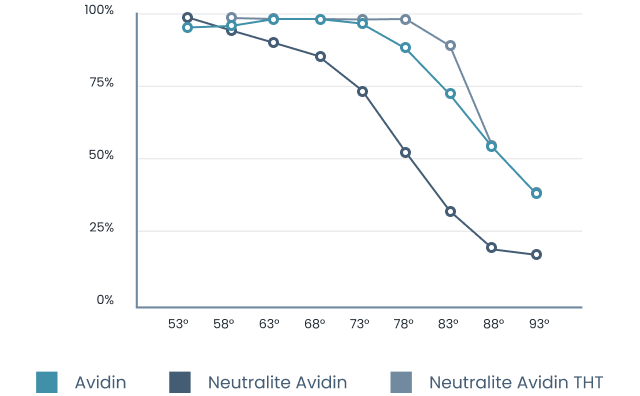
In 2015, e-Proteins launched a R&D program to meet customer requirements for high-temperature coating applications. We focused on comparing the heat stability of avidin, Neutralite Avidin, and n-ULtraCoat70 in a 50mM NaPi pH 7.0 setting. Our team determined Delta(50), the temperature causing a 50% loss of initial activity after 30 minutes.
Our efforts led to the development of NLA-H, which surpasses both Neutralite Avidin and streptavidin in heat stability. NLA-H shows a significant Delta(50) improvement, reaching approximately 83°C after 30 minutes. Building on this, we are developing NLA-XH, aiming to match the remarkable heat stability of native avidin, around 89°C over 30 minutes.
Currently, these new derivatives exhibit high temperature resistance, but they lose 15% of their activity after 48 hours. Our team is actively working to stabilize these products over time, ensuring they meet the high-temperature demands of our clients.
Expanding Applications of Heat-Resistant Neutralite Avidin in Biology
The high-temperature-resistant Neutralite Avidin has opened up a plethora of opportunities in various biological applications where high temperature resistance is essential. This enhanced feature makes it an ideal candidate in several key areas.
Firstly, in Polymerase Chain Reactions (PCR), where thermal cycling is a fundamental process, the heat-resistant Neutralite Avidin can play a crucial role. Its ability to maintain functionality at elevated temperatures ensures more efficient binding and signal amplification, leading to more accurate DNA amplification results.
Secondly, in protein purification processes, especially those involving heat treatment to inactivate other proteins or contaminants, this form of Neutralite Avidin stands out. Its high temperature resitance allows it to remain active and effective in binding biotinylated molecules, even after heat treatments that would denature most proteins.
Additionally, in the field of immunohistochemistry, where tissue samples often undergo heat-induced antigen retrieval, Neutralite Avidin’s heat resistance is highly advantageous. It ensures that the binding of biotinylated antibodies to their targets is not compromised during the heating process, leading to clearer and more reliable staining results.
Moreover, in biosensor development, particularly in environments with fluctuating or high temperatures, Neutralite Avidin can significantly enhance the performance and stability of biosensors. Its ability to withstand high temperatures without losing activity ensures consistent and reliable biosensor readings.
Lastly, in food science and safety testing, where samples are frequently exposed to high temperatures during analysis, Neutralite Avidin’s heat resistance ensures it remains an effective tool for detecting biotin-labeled compounds in various assays.
In conclusion,the Neutralite Avidin’s high temperature resistance is a versatile tool
the new Neutralite Avidin derivative marks a breakthrough in protein stability at high temperatures. Surpassing native avidin, known for its heat resistance, this development highlights e-Proteins’ commitment to innovative research. We have set a new industry standard, offering a product that maintains functionality in extreme temperatures. This advancement underlines our dedication to providing cutting-edge solutions, effectively responding to the evolving needs of our customers.
Advancements in Specific Activity and Biochemical Efficiency
The specific activity of a protein is a crucial measure of its effectiveness in biochemical reactions. It refers to the amount of a substance produced or converted per unit of time under specific conditions. This metric is particularly important for Neutralite Avidin, a deglycosylated form of avidin, which exhibits a near-neutral isoelectric point of 6.3, greatly reducing non-specific binding.
This unique attribute, along with its high biotin-binding affinity, makes it ideal for precision assays where specificity is paramount. Additionally, its reduced molecular weight of 60 kDa enhances its solubility, boosting efficiency across various biochemical applications. The existence of Neutralite Avidin in polymerized forms (n-UltraCoat70 for lateral flow assay) further increases its binding capacity, proving beneficial in complex assays requiring heightened binding.
Elevating the Benchmark: Neutralite Avidin’s Journey to Optimal Purity and Activity
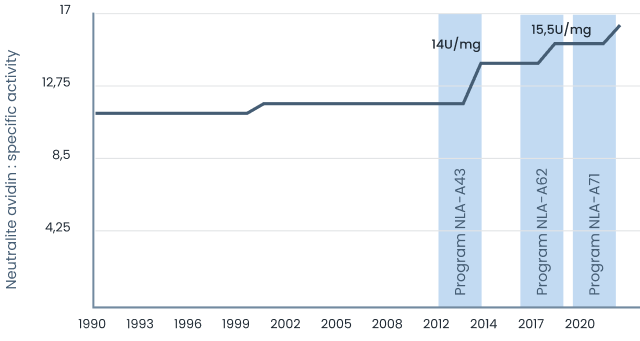
Specific activity improvement for Neutralite avidin
E-Proteins has been at the forefront of enhancing the quality of avidin products. From 2012 to 2014, significant investments in equipment and new technologies for avidin production led to achieving over 99% purity and more than 99.5% activity. This R&D initiative involved numerous investigations, some of which improved existing products, while others laid the groundwork for innovative derivatives.
Upon reaching maximum purity for native avidin, the focus shifted to its first derivative: Neutralite Avidin. Initially, in 1990, Neutralite Avidin had a specific activity of over 11 U/mg. The production process at that time was complex, and the specific activity was somewhat compromised by the chemical ingredients used.
In response, a new R&D program, NLA-A43, was initiated in 2015 with a simple goal: to improve specific activity. This endeavor was successful, elevating the specific activity to over 14 U/mg. In 2017, the ambitious NLA-A62 program aimed to further increase this metric to over 15.5 U/mg. This program concluded successfully in 2020.
Following these achievements, 2020 marked the beginning of another significant R&D program on Neutralite Avidin, targeting a specific activity of 16.6 U/mg, which represents the theoretical maximum for this derivative. This ongoing effort exemplifies the commitment to advancing the efficacy and versatility of Neutralite Avidin in various scientific and medical applications.
Next R&D program : A Targeted Approach to Molecular Weight Reduction
Future R&D on Neutralite Avidin will focus on reducing its molecular weight while preserving its unique properties. This effort aims to enhance the protein’s efficiency and functionality in biochemical applications. Researchers will analyze Neutralite Avidin’s amino acid sequence to identify and eliminate non-essential segments, streamlining the protein’s structure without affecting its biotin-binding affinity or reduced non-specific binding.
Advancements in protein chemistry and bioengineering will play a crucial role. Our Scientists team will apply innovative techniques to study protein folding and stability, ensuring molecular weight reduction does not compromise Neutralite Avidin’s structural integrity and function. Biochemical simulations and modeling will also contribute significantly, enabling predictions about the impact of molecular changes on the protein’s structure and function.
Moreover, the e-Proteins R&D team will employ advanced protein purification and characterization techniques throughout the process. They will continuously assess the modified Neutralite Avidin’s purity, specific activity, and binding capabilities. This rigorous testing guarantees the protein maintains high standards for various applications.
In summary, the future R&D effort on Neutralite Avidin will be a methodical and precise venture. The goal is to reduce its molecular weight without losing essential characteristics, enhancing its suitability for diverse applications. Through a combination of structural analysis, bioengineering techniques, and continuous evaluation, this focused approach aims to improve Neutralite Avidin’s overall efficiency.